
So You Wanna Be a Fighter?: Part One
By
Casey S. Rusbridge

It’s been a while since I’ve contributed an article to this site and so much has
changed. I relocated to Ottawa last June, changed careers (although not for the
better), and most importantly, changed sports. For a long time, I knew my
passion was in strength sports, but something else lingered inside.
The speech
“Let me explain something to everybody. This is a very—and when I say very, I
mean very—unique opportunity. If you’ve ever wanted to really be a fighter (and
when I say a real fighter, you wanna be like some of the guys on the wall in
here), this is fuckin unbelievable. It’s an amazing opportunity, right? You
don't have to worry about paying your fucking bills. You really don’t have to
worry about whatever’s going out on in the real world right now. We’ve gotten
some of the best grappling, boxing, muay thai coaches there are. You have
nothing to fucking worry about every day except coming in and getting better at
what supposedly you want to do for a living. You understand what I’m saying? How
bad do you want it?
We picked who we believe are the best guys in the country right now. We did. And
you guys are it. Fucking act like it, man. You are gonna fight in front of a lot
of people. A lot of people. You have no fuckin clue at the opportunity that you
have here. Any questions? Does anybody not want to be here? Does anybody not
want to win this fucking thing? Does anybody not wanna fight? Is that a no? Talk
to me. Do you wanna be a fucking fighter? Do you wanna be a fighter? That’s the
question.
It’s not about cutting weight. It’s not about living in a fucking house. It’s
about do you wanna be a fighter. It’s not all fucking ya know, signing
autographs and banging broads when you get outta here. It’s not. It’s no fucking
fun man. It’s not. It’s a job just like any other job. Being a fighter isn’t all
fucking girls and signing autographs. It’s fucking hard work, but you have the
opportunity to fuckin make money, be famous, and do something for the sport
here. That’s what this is all about.
So the question is not did you think you had to make weight, but did you think
you had to do this? Do you wanna be a fuckin fighter? That is my question. And
only you know that. Anybody who says they don’t, I don’t fucking want you here.
And I'll throw you the fuck outta this gym so fuckin fast your head will spin.
It’s up to you. I don’t care. Cool?
Have a good night gentleman.” —Dana White

The answer
Rewind to 2005—the Ultimate Fighter debuts on Spike TV. This is my introduction
to the sport of mixed martial arts (MMA), and it’s the UFC’s launch into the
social conscious of North America. Watching those guys sacrifice everything for
an opportunity to actualize their goals was intense to say the least. At
this time, I fell in love with MMA. To fight in the UFC meant you had to be the
most athletic, strongest, fastest, and most flexible, not to mention have a
mastery of the multifaceted disciplines of the stand up and ground game. People
tend to see the mediocre fighters as “cans,” fodder for the top dogs of each
weight class. What they forget is that each fighter isn’t just the best in his
gym. He’s the best in his city, his state/province, and his country. These are
bad mother fuckers.
Fast forward to 2008—I made a decision to give up a job with a decent wage to
move to Ottawa, pursue my passions, and begin my journey to self-actualization.
Arguably, this wasn’t the best decision financially, but the holistic benefits
outweighed the risks I knew I was taking. In case you don’t know, Ottawa is
Canada’s capital with half the population of Toronto. However, it is a hot bed
of MMA talent and strength athletes. We have several current and former
nationally ranked powerlifters and Strongmen gyms in the area. After reading
Martin Rooney’s
Training for Warriors book on my train trip to Ottawa and
an email consultation with Alwyn Cosgrove, I decided to switch sports. It was
time to answer the question burning inside. Was I going to be the guy in the
stands cheering or the man on the mat listening to the audience?
I’ll save the transition story from powerlifter to MMA athlete for another day.
After making the decision to become a fighter, I chose to train under
professional fighter Craig “Farmer” Brown at FIT MMA (http://www.fitmma.ca/).
The school is a mix of experienced guys, a few professionals, and a lot of
potential talent. It’s a small school compared to many in the city, but I have
never felt such a part of a team or a family as I have at FIT. Craig is a hell
of a coach and a great fighter in his own right, with a recent title fight on
June 13, 2009 with W1 MMA.

The goals
Why am I writing this article? Well, on June 28, 2009, there was a sport MMA
tournament held in Gatineau, a neighboring city to Ottawa just across the Quebec
border. Now, for those unfamiliar with the MMA scene, sport MMA is more of a
“points” based system for fighters to work under live sparring and watered down
rules. The rounds are shorter, and the striking is softer to avoid injury. Our
school has a philosophy that every fighter should work through a farm league
before getting a professional fight. There is no reason to rush anyone into a
legit fight who hasn’t been battle tested first.
My primary goal was to win my weight class and division with “just medaling”
being a less than satisfactory alternative. Any other result constituted a
failure in my opinion. If the fights went well, I intended to request a legit
amateur fight later this year. Needless to say, I had high expectations, and my
plan to become a professional fighter was tied to the outcome of this
tournament. This represented step one in a journey to reach my potential.
Brief overview
My strength background is in the Westside method of powerlifting, and I was
incredibly deconditioned. It has been an ongoing process, but using Martin
Rooney’s
Training for Warriors conditioning sessions, I’ve made dramatic
improvements. Hurricane training is brutally intense but ultimately satisfying
in a way that I can’t describe. Check out his website and YouTube channel for
more information (http://www.youtube.com/user/TFWarriors1)
or you can purchase his book and DVD on this site. I highly recommend
that you purchase both the book and the DVD as they complement each other and
give you a better understanding of the system together.
After months of experimentation with my strength programming, I stumbled
across a satisfactory methodology that improved my work on the mat. Anything
that detracted from performance was eliminated or modified. It’s been an
incredibly difficult process of changing my philosophy regarding balancing
weight lifting and MMA training. I still want to squat, pull, and bench as much
as possible, but that isn’t necessarily going to help me on the mat.
Martin’s system is responsible for my conditioning, and a modified version of
Jim Wendler’s
5/3/1 pendulum is the basis for my strength program. I needed
something that didn’t promote an incredible amount of volume and wouldn’t be too
taxing on my central nervous system but at the same time would keep me strong.
Training schedule
Sundays: Rest day
Monday: 2–3 hours of BJJ and MMA training
Tuesdays: 1 hour of MT, weight training session “A” two hours later
Wednesday: 2–3 hours of BJJ and MMA training
Thursday: 1 hour of MT, weight training session “B” two hours later
Friday: Open mat session (this is unstructured and may include sparring,
rolling, boxing, or rest)
Saturday: 1 hour MT followed by 1 hour MMA training (or rest), 1–1.5 hours
hurricane/conditioning session
Notes: All weight training is performed wearing a heart rate monitor with the
goal of keeping my heart rate above 160 bmp. I moved on to the next set as soon
as my heart rate dips below that point (within reason). Longer rest periods were
required when removing plates from the bar, etc. All conditioning work was
performed while wearing my competition mouth-guard. I find this made an
incredible difference in my “gas” on the mat, as I was adapting to my limited
oxygen intake. This is also a great way to monitor how the conditioning work
impacted my sport-specific work as I eliminated a “variable.”

Program outline
“A” session
1. Sprints
2. Deadlifts
3. Main upper body, dips, dumbbell floor bench
4. Olympic lifts, cleans, high pulls
5. Rows
6. Lower assistance/rep work, front squats, Zercher squats/lunges
7. Ab work
8.
Foam roller
“B” Session
1. Sprints
3. Upper body lifts, military press, dynamic medicine ball passes
4. Chins, chin-ups or pull ups, series
5. Lower assistance/rep work, box jumps, dumbbell grappler’s lunge
6. Weighted ab work
7. Stretch
Detailed breakdown
Exercises noted as “1” will be performed for the first two weeks of the program,
and “2” indicates exercises performed on weeks three and four.
Weight session A
A) Treadmill sprints: After warming up on the treadmill, I performed a series of
sprints on a 10% incline with 30 seconds of rest between runs.
Round 1: 9, 10, 11 mph at 10% incline X 20–30 seconds
Round 2: 12, 13 mph at 10% incline X 15–20 seconds
Round 3: 14, 15 mph at 10% incline X 10–15 seconds
Notes: The sprints were waved by raising the time by 2–3 seconds per week
leading up to the tournament. All sprints were performed wearing my mouth guard
to adjust to the oxygen intake deficit that would be encountered while on the
mat.
B) Deadlift
Week 1: 60% X 5, 65% X 5
Week 2: 70% X 5,75% X 5
Week 3: 80% X 5, 85% X 3
Week 4: 90% X 3, 95% X 1
Notes: I find that the volume is a bit lower with this progression but less
taxing on my system. It allowed me to easily hit my goal of getting stronger and
filling out in my weight class.
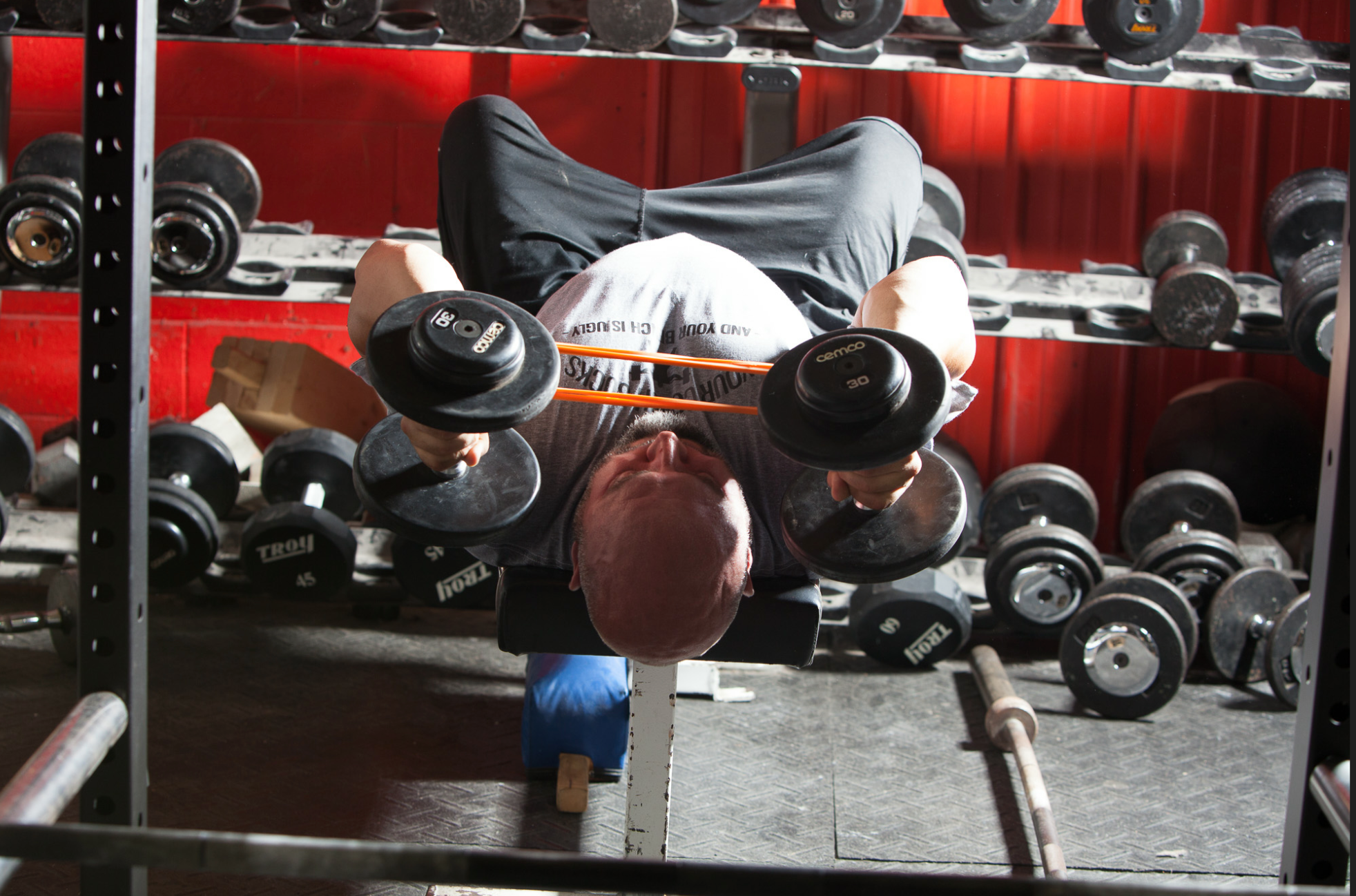
C1) Dumbbell floor press: Weights were performed in the 8–20 rep range with
goals to increase the weight in every cycle.
C2) Dips: I either attempted to set a body weight only record or performed
weighted reps based upon a 2RM.
D1) Cleans: Every rep was started on the knees to promote hip speed and
flexibility. Reps were 6–10 or more X 2 sets. Week one was performed with a
lighter weight for a greater number of repetitions (e.g. 135 X 10) with the next
session being a heavier session (185 X 8 X 2)
D2) High pulls: This follows the exact template as the cleans in terms of
reps and sets.
E) Rows: These can be any variation of a row (barbell, hammer strength,
dumbbell, or dumbbell power clean). Reps are 8–30 (used the “Kroc” L.A.T. method
at least twice a month) for 2–4 sets.
F1) Front squat: This was repetition training with less emphasis on
increasing weight by volume. Reps were 8–10 X 2 sets minimum.
F2) Zercher squats or Zercher grappler lunges: Thus used the same rep/set
template as front squats. Zercher grappler lunges were intended to mimic
shooting in on an opponent for a takedown and were done in a squat rack.
G1) Medicine ball abdominal series: There are many different exercises to
choose from, and I performed them with little rest using a medicine ball as
resistance. The final exercise was standing on a half Bosu ball to develop some
balance.
G2) Grappler twists and grappler Thai knees: These were very simple exercises
performed in a superset. The goal was to gradually increase the weights used in
the 20–25 reps X 2–3 sets.
H) Foam roller work: This was performed for 5–10 minutes (as needed).
Weight session B
A) Treadmill sprints: These were performed in the same method as previously
described.
B) Squats
Week 1: 50/55/60% X 2 X 8–10
Week 2: 65 X 5, 75 X 5
Week 3: 80 X 5, 85 X 3
Week 4: 90 X 3, 95 X 1
C1) Military press: Week one was a 5RM, and week two was a 3RM.
C2) Standing medicine ball: The goal was to set a rep record for time (30
seconds set X 3–4 sets, 30 seconds rest between sets).
D) Chins/pull-ups: One session a month was a body weight series consisting of
chins, pull-ups, half rep chins, leaping alternating grip chins, chin
side-to-sides, and finally grappler hand walks. (Visit
http://www.youtube.com/watch?v=yyix2Z-xL-8&feature=channel_page for examples
of the last two exercises). Another session was performed for a body weight
record, and the remaining sessions were weighted chins/pull-ups only.
E1) Box jumps: I am limited to using a 20-inch box, so I sat on a half Bosu
ball spaced 18 inches away from the box and performed a set of body weights
jumps for 10 reps as a warm up. Then, I did weighted jumps for 10 reps X 2–3
sets.
E2) Dumbbell grapplers lunge: This is a traditional lunge with a Training
for Warriors’s twist—the dumbbells are brought together under the knee
before ascending. Check out Martin’s YouTube channel for an example.
F) Weighted ab work
Week 1 and 2: Standing cable abs and leg raises
Week 3: Spread eagle sit-ups and leg raises
Week 4: Barbell crunches and leg raises
H) Stretching
In my next article, I will outline the specific conditioning drills I performed
to develop and increase my level of conditioning.
Casey S. Rusbridge is an aspiring MMA fighter living in Ottawa, Ontario,
Canada, and trains out of FIT MMA under Craig Brown. He has a background in
powerlifting and a degree in film studies through Carleton University. You can
find his other articles, including his training leading up to his first IPF
meet, here on EliteFTS.com. Potential sponsors and anyone wishing to contact him
with questions or constructive criticism are welcome to by emailing him at
c.s.rusbridge@gmail.com.
Elite Fitness Systems strives to be a recognized leader in the strength
training industry by providing the highest quality strength training products
and services while providing the highest level of customer service in the
industry. For the best training equipment, information, and accessories, visit
us at www.EliteFTS.com.